 Jinmao
1. The Industrial & Commercial Dynamics of the United States Ladies Apparel Market
The United States apparel industry, specifically the ladies’ trousers and athleisure segment, is undergoing an unprecedented structural transition. Valued at over $30 billion annually, the domestic market for women's pants has expanded beyond traditional classifications. The contemporary American consumer requires high-performance transitions—garments must move seamlessly from corporate environments to remote work lounges, fitness spaces, and social arenas.
Currently, domestic commercial production in the United States faces severe headwinds, primarily driven by escalating labor overheads, lack of vertically integrated raw material reserves, and strict compliance regulations within state-level manufacturing facilities. High-density apparel clusters like Los Angeles and New York are pivoting away from heavy assembly, focusing instead on hyper-local custom prototyping, brand marketing, and direct-to-consumer distribution channels. Consequently, leading American enterprises rely extensively on robust global supply systems capable of rendering complex fabric architectures with strict sustainability baselines.
Within the United States, pants and activewear requirements dictate high tensile strength, precise fit consistency across diverse body shapes (petite, standard, and plus-sizing systems), and verified raw materials that satisfy consumer demands for eco-stewardship. Brands are seeking strategic suppliers that operate with structural transparency, offering certified supply frameworks to offset the regulatory challenges of modern cross-border logistics.
2. The Chinese Supply Chain Advantage: Ningbo Jinmao's Operational Capabilities
As a premier global textile hub, the city of Ningbo represents the pinnacle of vertical industrial integration. Founded in the year 2000, Ningbo Jinmao Import & Export Co., Ltd. has spent over two decades navigating global market volatilities, scaling our operations to achieve an annual turnover exceeding $30 million. By consolidating regional raw material sourcing, automated dye-houses, structural cutting facilities, and auditing expertise, we offer a level of production security that domestic US factories cannot replicate.
Under the stewardship of our professional leadership, our corporate ecosystem incorporates:
- ISO9001:2015 & ISO14001:2015 Certifications: Establishing a standard for quality assurance metrics and environmental sustainability systems.
- Over 50 Senior Specialists: Navigating global trade lanes, specializing in lightweight woven developments, knit engineering, and international customs policies.
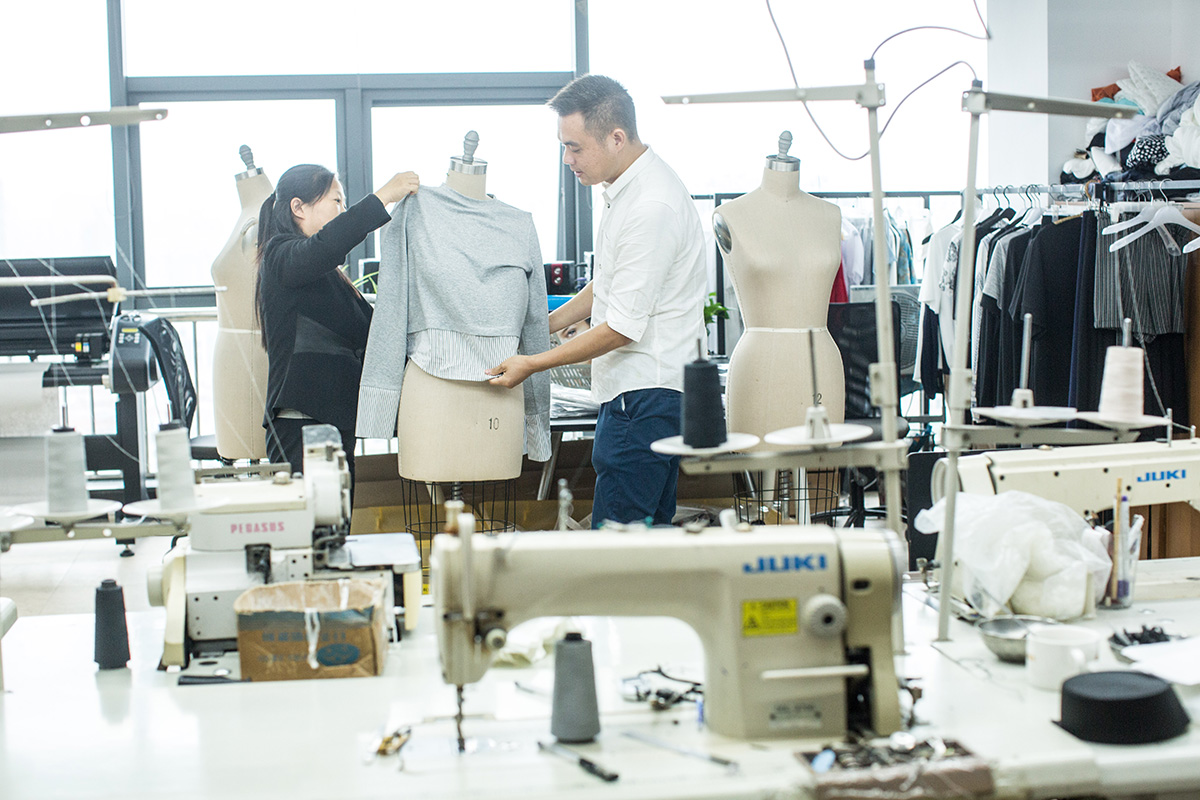
- High-Efficiency Prototyping: An in-house design and pattern-making department capable of transforming sketches, tech packs, or visual photos into physical fit samples within 7 to 14 days.
- Regional Factory Distribution: Strategic production units established in Jiangxi, Anhui, Henan, and Zhejiang to manage multi-tiered capacity needs.
24+ Yrs
Industrial Expertise
$30M+
Annual Export Value
30+
Audited Partner Factories
10M+
Annual Production Output
3. Technical Anatomy of High-Performance Fabrics & Sustainable Curation
Sustainable product differentiation begins at the yarn level. Modern United States consumers demand verification of fabric components, leading brands to seek raw materials that possess Global Recycled Standard (GRS), Better Cotton Initiative (BCI), and Oeko-Tex Standard 100 certifications. Ningbo Jinmao provides a deep catalog of material innovations:
Scuba & Interlock Fabrics
High-gauge, double-knit polyester-spandex configurations that offer thermal regulation, structural rigidity, and clean drape profiles for modern ladies' pants.
Eco-Conscious Wovens
Organic cotton blends, Australian cotton, Lenzing Modal, and post-consumer recycled polyester engineered for structural resilience and moisture management.
Fleece & French Terry
Sherpa fleece, polar fleece, and combed French terry providing high warmth-to-weight ratios for North American seasonal layering collections.
Comprehensive Raw Material Directory
Our collaborative supply matrix ensures access to specialized fabric families designed to perform under rigorous retail conditions:
- Scuba Fabric: Optimized for structural silhouettes, providing smooth surface textures.
- Coral Fleece & Sherpa Fleece: Engineered for cold-weather insulation.
- French Terry/Fleece: Loopback constructions offering comfort and moisture absorption.
- Interlock: Tight double-knit structures preventing run-out and fiber fraying.
- Pique & Rib: Offering surface texture and dimensional recovery.
- Polar Fleece: Lightweight, anti-pilling insulation for technical mid-layers.
- Single Jersey: High-gauge fabrics for base layers, blends of sustainable modal and cotton.
4. Surface Embellishments & Advanced Manufacturing Techniques
Product distinctiveness is amplified through specialized textile finishing and branding methods. At Ningbo Jinmao, we combine automated embellishment technology with manual craftsmanship to achieve high-fidelity applications:
- Digital Print: High-resolution, multi-chromatic designs with minimal water consumption and high color fastness metrics.
- Discharge Print: Chemical removal of dye from base materials, replaced by vibrant colors to maintain fabric softness.
- Flock Print: Application of micro-fibers onto adhesive bases, creating structured, velvet-like surface textures.
- Water Print: Soft-hand ink applications ideal for lightweight summer fabrics, maintaining breathability.
- Embossing: Calendered heat-treatment forming persistent, three-dimensional patterns on polyester and scuba substrates.
- Fluorescent Print & Glow Accents: Visibility elements designed for safety in ladies' activewear and running tights.
- Industrial Embroidery: Automated multi-head platforms executing dense logo embroideries, beadwork, and structural reinforcement.
- Garment Post-Processing: Acid washes, garment-dyeing techniques, and silicone softening treatments.


5. OEM & ODM Framework: The Lifecycle of a Purchase Order
Managing risk across long international distances requires a clear, step-by-step product development framework. Ningbo Jinmao operates a structured process to ensure safety, quality, and on-time delivery:
Concept & Digital CAD
Collaborative design consultation. Our team converts brand sketches, mood boards, or competitor imagery into comprehensive 3D design files.
Fit Sample Engineering
Physical creation of prototypes using correct base weights to verify pattern accuracy and fit drape before committing to main fabric runs.
Pre-Production Verification
Development of a pre-production sample utilizing final customized dyes, prints, labels, and packaging elements for final approval.
Bulk Production & QC
Activation of specialized production lines. Dedicated quality control officers conduct in-line checks and pull samples for third-party lab testing (SGS/BV).
Shipment Audit & Release
Pulling final shipment samples for client review. Packed cartons are systematically labeled and loaded into containers under direct supervision.
Duty-Optimized Logistics
Processing customs clearance document packages (Origin certifications, chemical compliance declarations) to minimize duty cycles at US ports.
6. Sourcing Realities: Addressing Minimum Order Quantities (MOQ) and Supply Chain Agility
For mid-sized and growing brands in the United States, managing high inventory minimums presents a major operational challenge. Ningbo Jinmao addresses this concern through our Flexible Supply Chain Ecosystem.
By partnering with over 30 certified factories, we maintain access to diverse manufacturing capabilities. Our production partners scale from boutique workshops, suitable for small collections (under 500 units per style), to high-capacity facilities with over ten automated production lines designed to execute high-volume contracts (100,000+ units).
Furthermore, we keep strategic reserves of greige fabrics and standard yarns. If a brand cannot meet the minimum dyeing requirements for a specific fabric, our merchandisers provide access to alternative certified stock fabrics. This operational model reduces development lead times, limits fabric waste, and enables brands to test consumer response before scaling up production.